BROWNE INNOVATION GROUP

Wednesday, May 22, 2013

BIG’s Blog: Nobody wants to be sold


You don’t like to be sold.

I don’t like to be sold.
In fact, nobody we know likes to be sold.
So why does everyone keep trying to sell me?
Yeah !
But wait a minute. Come to think of it, I can’t exactly remember the last time someone really put the squeeze on me to buy something. Not a car salesperson, not a clerk in a store in the mall, not even my insurance guy.
Hmmm.
I think something has started to change. Yes, occasionally I run into a person who tries to get me to buy the more expensive product instead of the one I came into buy. . . but at those moments, it seems oddly strange; as if he didn’t get the memo from his boss saying, “don’t hassle the customer.”
Buying a car is no-hassle/haggle pricing. At the store in the mall, if they don’t have your size in that color, they will have it shipped to you without a shipping charge. Even my insurance company offers me discounts if I bundle my house and cars together…but there is no follow up call…it’s my choice.
Hmmm.
But then I still get those heart-tugging appeals in the mail. And even if I know some of the organizations and have even given to some of them in the past… I still feel, you know, kind of like I’m being sold.
Is this just me? I don’t think so.
Direct mail is a percentages game. And, frankly, as long as you still have enough Depression and WWII generational cohort prospects in your mix, the percentages favor you. But then all the prospecting files are shrinking because the Depression and WWII generational cohorts are shrinking.
So, since we determined that “we” (you and me) don’t like to be sold, and since we are of the Baby Boomer generation, it is safe to assume that something in the ethos of the Boomers has changed.
Definition of Ethos: 

The fundamental character or spirit of a culture; the underlying sentiment that informs the beliefs, customs, or practices of a group or society; dominant assumptions of a people or period.
So you have a fundraising business model that generates transactions… or not. The prospect either donates… or not.
Isn’t that like being sold?
There is an alternative to the transaction-based model and that is the relationship-based model.
Join us.
-Mike
Welcome to BIG's Blog!  Please feel free to forward this post to your friends and coworkers...and email me a comment at: mike@big-db.com

Monday, May 20, 2013

BIG’s Blog: Join the 1%


The Pareto principle rules today, but for how long?

What’s the Pareto principle? Back in 1906, and Italian economist by the name of Vilfredo Pareto observed that 80% of the land in Italy was owned by 20% of the population. Wondering if it was a fluke, he checked other countries in Europe with pretty much the same results. Then he started looking at all categories. When he observed that 20% of the pea pods produced 80% of the peas, he published his findings. Today we know it as the 80/20 rule.
Today the Pareto principle works in nonprofit fundraising as well . . . but for how long? Are we headed into a time when a few dominant nonprofits… maybe 1%... dominate 99% of the donations?
The Internet is changing everything, including…possibly… the Pareto principle???
If that happens, where does your organization fit? In the 1% of winners, or the 99%?
Maybe the better question is, how could this happen?
Actually, it is already happening, and in quite an ingenious (as well as scary) way for those on the other side. The “new class” of growing fundraising organizations focus -first and foremost - on developing relationships.
“But…but”… you say, “we focus on relationships too.”
No you don’t. You focus on raising money, on closing transactions.
Your number one focus is raising money. Honestly, the relationship is a “nice to have,” but your focus is “on the money.”
You’re using the same fundraising model that your predecessor used and her predecessor before her etc. Your fundraising model is a “transaction-based” model that is at least 80 years old. And just like when we were kids and there were only three television networks… CBS, NBC and ABC… we lived that world, because that is all there was. Until recently, your transaction-based model was essentially the only model there was because the world was organized the way the world was organized.
But things really began to change for fundraisers five years ago, and in the last three years they have really begun to accelerate. That was when everything technological came together (high speed broadband, smartphones and tablets, social media, etc.) and hit critical mass. Even pricing structures for technology accessed through the cloud is bringing down costs dramatically.
So what is the “new fundraising model?” Like I said earlier, it is a “relationship-based” model.
Look around. What does it cost to generate a friend online? Even if you are not personally engaged much online, you know, for instance, it costs nothing to set up a Facebook page. So humor me . . . what do you think it costs to build a relationship online?
You say, “it won’t work for nonprofits, nobody will develop a serious relationship online with us?”
Really?
You have heard of Match.com or eHarmony? Online match-making Web sites?? I’ve got news for you, not only are people developing serious relationships online, some are actually finding life partners and getting married. How does the seriousness of the marriage relationship compare to the seriousness of a nonprofit supporter relationship?
Keep focusing on transactions and watch your numbers keep declining. Or, start developing relationships and join the 1%.
Think you can’t change?
Join us.
-Mike
Welcome to BIG's Blog!  Please feel free to forward this post to your friends and coworkers...and email me a comment at: mike@big-db.com
Friday, May 17, 2013

BIG’s Blog: Don’t stop mailing to my mother!


My mother is 86 years old. If you quit mailing your appeals to her and her friends, they will most assuredly stop sending you checks. Don’t do that!

Keep sending your appeals by mail to my mother.
What, however, is your plan once my mother and her generational cohort are no longer capable of sending you donations?
What is your Plan B?
That is the real question, NOT… ”To mail or not to mail?”
Can you still acquire new donors by mail? In general, the answer is yes. But it is a complex question depending on the unique dynamics of your charity. But, in general, yes.
Can you build your organization’s future donors on direct mail appeals? In general, no.
Is there a contradiction there? Absolutely not.
The truth is, everyone, including the direct mail industry, knows this. The American Cancer Society’s announcement that they were terminating direct mail acquisition appeals set off a firestorm of conversations. Suddenly, fundraisers woke up to a major name in direct mail fundraising actually doing what many other fundraising organizations should be doing, and that is looking at their long-term strategy.
But then the knee-jerk comments started. It was if the pendulum swung all the way to the other side overnight. “Abandon direct mail, abandon direct mail,” went the cries from fundraising organizations across the land.
That’s just silliness!
Well, what’s the alternative to direct mail? The obvious answer is online, but the not so obvious answer is that a successful fundraising strategy that is 100% online is an Apple to direct mail being an Orange. Like the old saying goes, they are Apples and Oranges. It is not reality that an Apple (a successful direct mail effort) will turn into an Orange (a successful online strategy) at some point in the future. They are two completely different and separate fruits.
The direct mail industry has its methodologies to keep fundraisers successful with direct mail appeals.
Browne Innovation Group and others have their methodologies to make fundraisers successful with an online strategy.
Can they work together? If you want to remain successful and get back on the growth path in fundraising, you had better be employing both today.
They are Apples and Oranges…but today, you need both to remain healthy in fundraising.
Join us.
-Mike
Welcome to BIG's Blog!  Please feel free to forward this post to your friends and coworkers...and email me a comment at: mike@big-db.com

Wednesday, May 15, 2013

BIG’s Blog: A peculiar dynamic begins again


Every once in awhile, something just really gets to me and I write an overly harsh blog. Then a funny thing happens... a peculiar dynamic cycle kicks in. Invariably following the “harsh” blog, over the next week as people read it, some are hurt or offended and cancel their subscription. It happens like clockwork. A short-term surge in cancellations.

Then, a strange thing happens over the following few weeks, I get a bigger than normal surge of subscribers. I understand the un-subscribers... I just don’t yet understand why there is a surge or where these new subscribers are coming from.
My readers know that we have transformed Browne Innovation Group from a traditional consulting organization delivering our consulting service in-person and on-site into an e-learning and online coaching delivery model. This has allowed many more organizations to be able to afford our program and learn our new fundraising model. We only have two classes per year because the courses cover five months: January through June and July through December. Our next class starts July 6th.
Here is the thing... those who take a look at our online program, Acquiring the Next Generation of Supporters, fall into two distinct groups.
The first group “gets it” immediately and moves to sign up their organization. They admit their direct mail is declining in profitability, and even their events are getting smaller and smaller and grayer and grayer. They know they have to change . . . and even if they are initially skeptical about our program being the end-all panacea, they usually are impressed with the other organizations that have taken the program. Either way, they see no alternative and they need a Plan B.
Then there is the other group. They either don’t want to talk about their current fundraising results (other than to say it is better than last year), or they want to tell me that even though things aren’t looking good, they just know their leadership or board wouldn’t go for something like this.
When I ask them what their Plan B is, it is as if they fear for their jobs even if things are in decline. Huh? If you DON’T change directions, who is going to get the blame? I even explain that what they are facing in the decline in fundraising results isn’t really their fault; they are simply facing two huge societal shifts: A) a major shift in generations and B) society’s shift to digital forms of communications. But they can’t or won’t move.
I like the word “embrace.” A friend of mine told me that the only way you’ll survive in fundraising is to learn to embrace the struggle.
Join us.
-Mike
Welcome to BIG's Blog!  Please feel free to forward this post to your friends and coworkers...and email me a comment at: mike@big-db.com

Monday, May 13, 2013

BIG’s Blog: Ramifications of chopping down forests


Is it just me or do you have trouble getting your head around your "carbon footprint?” Does anyone really know what that is in concrete terms?

It seems my 20-something daughters intuit that we are killing our planet through our burning too much fossil fuels…pollution, warming temperatures.
I don’t know.
But here is one thing I know for sure:  In my lifetime of direct mail marketing…30+ years… I have personally been responsible for a lot of chopped trees. Sometimes, in a quiet moment I shudder at the forests I have personally been responsible for chopping down. And yes, I know trees are a renewable resource, but trees do a lot of other really good things while they stand, like clean the air. And, of course, unlike annual crops like wheat, corn, or avocados, trees take a long time to grow.
How do I know some of this stuff about trees? Well, the Arbor Day Foundation happens to be in my hometown. But then, the Arbor Day Foundation mails tons of direct mail every year…so.
I know that direct mail appeals have carried your organization for decades, and you are worried that there isn’t a viable alternative. I understand that. But there really is a viable alternative, and it is called the Internet . . . and the viable alternative model of fundraising that is 100% online isn’t just an electronic form of direct mail marketing.
I also “get it” that you think you know how to do this . . . but you don’t. Neither did I when I started.
What works online is building relationships and then…and only then…asking for support. No, it is not transaction-focused like the way you practice fundraising today. It is relationship focused.
It is very different than the way you are practicing fundraising today.
It is also very green.
Join us.
-Mike
Welcome to BIG's Blog!  Please feel free to forward this post to your friends and coworkers...and email me a comment at: mike@big-db.com

Friday, May 10, 2013

BIG’s Blog: Quit thinking about a faster laptop!


The iPad…the first tablet…wasn’t a new type of computer, it was a whole new category. Some even called it a game changer. It was the beginning of a whole new way of computing and connecting via a mobile device.

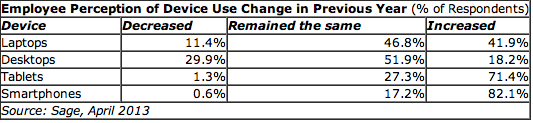
The Center for Media Research just reported The Sage SMB Survey on Mobile Devices. According to the survey, the most common devices that were used remotely by employees to access work-related information were: laptops (80%), smartphones (81%), and tablets (59%). But remember, the iPad is barely three years old. Smartphones are topping laptops? Seriously?
The following chart gives an indication of what’s increasing in usage and what’s decreasing between laptops, desktops, smartphones, and tablets.
Both laptops and desktops are showing decreasing usage by low double-digits, but look at the increased usage of tablets and smartphones: high double-digit increase in usage percentages (over 70% and 80% growth respectively).
Do you think something is going on out there?
Working people accessing their work related information over their smartphones and tablets. Hmmm???
Then the question is, what are they accessing their personal information on? That’s right… the same devices. Work-related activity on the same devices as personal stuff. As goes work…so goes personal.
So what can fundraisers learn from this?
Simply this, the behaviors are changing “quickly” in how people access information. Your messages are information. If you are not moving heaven and earth… right now… to be accessible on tablets and smartphones (where you can grow), you will only shrink. Potential supporters won’t wait around for you to figure it out; they will connect with the charities that connect to them and talk to them…where they’re at.
Join us.
-Mike
Welcome to BIG's Blog!  Please feel free to forward this post to your friends and coworkers...and email me a comment at: mike@big-db.com

Wednesday, May 8, 2013

BIG’s Blog: Is fundraising losing its soul?


There are a lot of nonprofit organizations that do really fantastic work and have passionate supporters.

There are, however, vast numbers of nonprofits who don’t have passionate supporters but still do fantastic work.
What’s the difference?
Sr. Judy reminded me last week that the difference is “being generous.” Frankly, I had never looked at it that way, but she was right on.
To younger generations, starting with the Baby Boomers, fundraising has come to seem too mechanical, too industrialized. I’ve written about this in the past . . . so many fundraising articles and blogs focus on the Five Point plans or the Six Tips that guarantee success. They are out there in such profusion that we are tempted to believe that if we only incorporate these keys to success, our donations will skyrocket. We are even coached to put more emotion into our appeals . . . as if the reality behind many missions isn’t heartbreaking enough.
It is as if we believe money is hard to come by in America. Really? The average trip to get groceries is $75, what is a $30 check to your charity?
This isn’t to denigrate the donors. At least they are stepping up to the plate, and thank God for them!
But what are we in fundraising doing to be generous to our supporters?
Some organizations and their fundraising groups have this down. Their number one priority is all about developing relationships. But others … especially when the fundraising organization has gotten large… are they generous or mechanical?
I think the key question is, do you tip relational or transactional?
Does your fundraising team worry first about their organization taking care of the needs of supporters (that’s a relational mind-set), or do you believe that the supporter donations are to take care of your organization (that’s a transactional mindset)?  
Both mindsets can raise money in America, but which mindset is being generous?
Join us.
-Mike
Welcome to BIG's Blog!  Please feel free to forward this post to your friends and coworkers...and email me a comment at: mike@big-db.com

Monday, May 6, 2013

BIG’s Blog: Are you risk averse?


According to Wikipedia, the meaning of “risk averse” is “a concept that plays out typically in the fields of psychology, economics, and finance based upon the behavior of people that are exposed to uncertainty and seek to attempt to reduce that uncertainty.”

I think it plays out in every field of endeavor, including fundraising.
Why do I ask you to consider whether you are risk averse? Because a lot of fundraisers believe that making major changes in the way they might practice fundraising might be a risky move. “What don’t I understand? What happens if I mess up? What happens if it doesn’t work?”
In other words, they worry about what they don’t know.
I understand that. I think everybody understands that. That is precisely why we created our online learning program to educate fundraising professionals about what has shifted in the fundraising world, and why the current methods of fundraising aren’t working well today . . . and to show them a path to engagement with younger supporters that can dramatically increase revenue.
But this blog isn’t about selling you on us. It’s about having you start thinking about what has changed in fundraising and what must be done about it.
If you are risk averse, you need to think about how the greatest risk can be mitigated.
First, you have to figure out what the greatest risk is.
Is the biggest risk moving to transform your fundraising away from purely a transaction model to one that seeks out first relationships and engagement via the Internet and then asks for support? Or, is the greater risk in NOT moving or changing the way you are practicing fundraising today?
One thing is certain…both paths involve risk. One path offers almost guaranteed failure, while the other path offers conditional risk. What is conditional risk? Conditional risk is, for example, the possibility that you can’t learn a new fundraising model and execute its strategy.
So then, what is the greater risk? Stand pat or move to shift your game?
Join us.
-Mike
Welcome to BIG's Blog!  Please feel free to forward this post to your friends and coworkers...and email me a comment at: mike@big-db.com

Friday, May 3, 2013

BIG’s Blog: Think Back 30 Years to 1983


1983.

To many of us, it seems like yesterday . . . and maybe that’s the problem.
President Ronald Reagan announced that the Global Positioning System would be made available for civilian use. Best Buy began selling music in its stores via cassette tapes. The Challenger Space Shuttle made its first flight. Margaret Thatcher was re-elected Prime Minister in a landslide election . . . and your Development organization had another successful year of direct mail fundraising.
2013.
President Ronald Reagan is gone, but today virtually everyone has access to the Global Positioning System (GPS) via their smartphone.
Cassettes gave way to CDs, which gave way to streaming downloads of music through the iTunes (and others) store, and you can’t buy music at Best Buy anymore.
In 1986, the Challenger Space Shuttle blew up 73 seconds into its flight. Today, the Space Shuttle program is history.
Margaret Thatcher served as Prime Minister of the United Kingdom from 1975 to 1990. Lady Thatcher died April 8th of this year.
And today, your organization continues to depend on direct mail appeals.
What’s the takeaway?
I’d say we are in a very different world than in 1983.  
Yet you are still dependent on the same direct mail-centric strategy?
How is that even possible?
Maybe because when you walk in the doors of your Development office, you believe there really isn’t anything new out there that can grow fundraising revenue again. Well, there is and it is.
Join us.
-Mike
Welcome to BIG's Blog!  Please feel free to forward this post to your friends and coworkers...and email me a comment at: mike@big-db.com

Wednesday, May 1, 2013

BIG’s Blog: What Lizanne Pando … and a lot of other Development Professionals are thinking about


Lizanne Pando sent me an interesting note on an article she had read.

Lizanne “gets it” that most fundraising, as it is practiced today, is focused on transactions. She asks, where did relationships go? Relationships? Well, most of the Development world talks a good game on relationships, but what we’re more concerned about is the money.
What has happened to “relationship” in fundraising? I mean, the whole point of calling the fundraising department “Development” is to keep us focused on developing relationships isn’t it?
Would you say “we’re developing money?” or, change the title of the Development Director to Money-Getter Director? No, of course not.
So how do we start thinking more relationally? Lizanne’s note gives some comparisons.
Transactional Relational
Professional Friendly
Self-interest Mutual-interest
Stay in touch Keep informed
Understand the process Understand the person in the process
Judge the results Evaluate the relationship
Win conflict Resolve conflict
Agreement Acceptance
As Lizanne’s note says, sometimes a transaction is sufficient, but transaction is never a good long-term strategy.
Beginning with the Baby Boomer generation, most people want a relationship with the charities they support. How are you planning to do that? What is your strategy for building relationships?
Join us.
-Mike
Welcome to BIG's Blog!  Please feel free to forward this post to your friends and coworkers...and email me a comment at: mike@big-db.com